That burning is more often too little acid than too much.
The standard answer to reflux runs: you’ve got too much acid, so we’ll knock it down. In a great many people it’s exactly the other way round, and the tablet that quietens the symptom for a few days quietly deepens the cause.
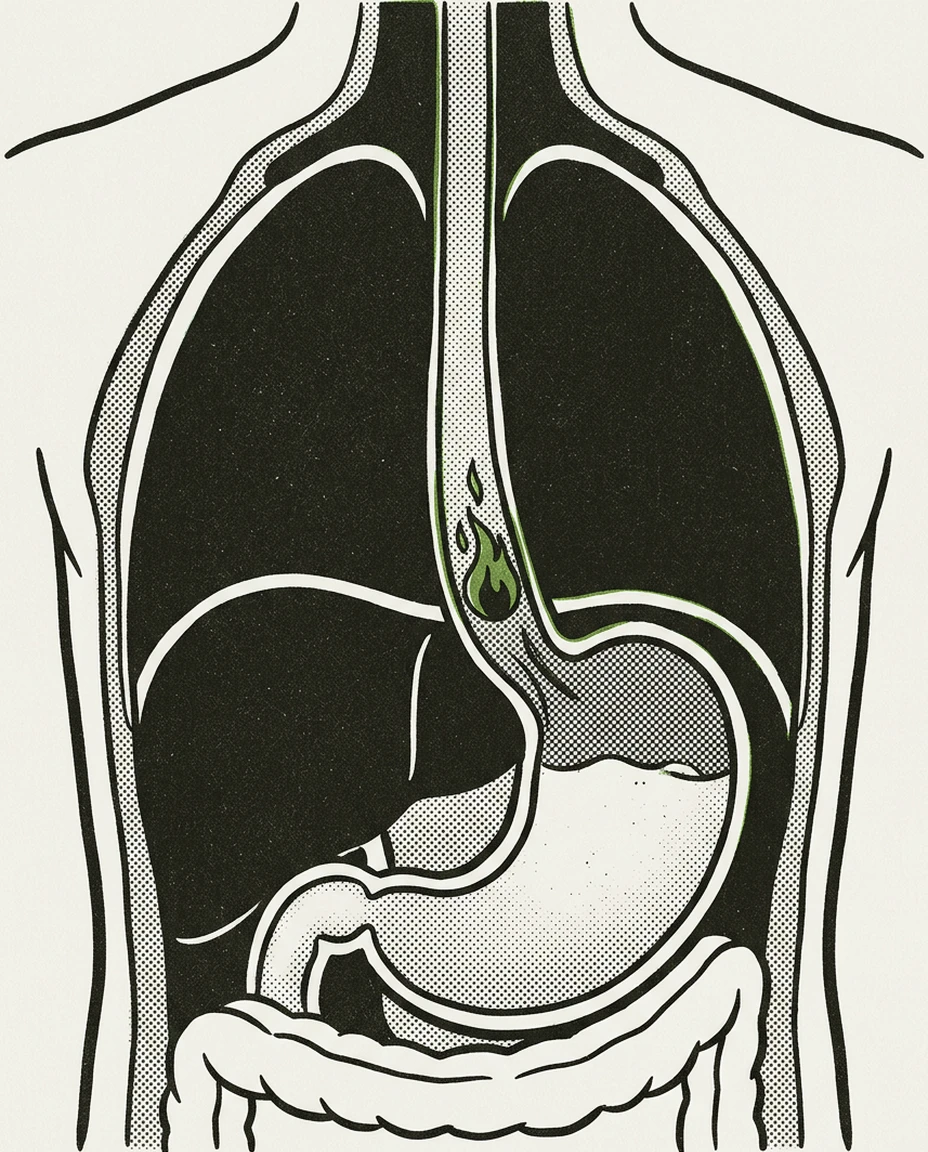
You lie down and within moments sour contents climb up towards your throat. You take an acid tablet, it’s better for a few days, then the same thing comes back, only more stubborn.
You get bloating, burping and a feeling of fullness high in the stomach, and after meat you feel it sitting heavy. Mornings bring a hoarse voice or a dry cough with no cold behind it, and any attempt to come off the tablets ends in burning worse than where you started.
This isn’t weak willpower or oversensitivity. It’s a mechanism that, in most people, is understood back to front.
“You’ve got reflux, so you must have too much acid.”
The commonest trap. The burning is acidic, so it sounds logical, but in a great many people, especially past forty and with signs of food sitting heavy, there’s too little acid, not too much, and the burning itself comes from fermentation gas. Knocking the acid down then quietens the symptom and deepens the cause, because protein digests even worse, fermentation grows, and the valve between stomach and oesophagus pushes the contents upwards.
There’s another way. It starts with understanding what really opens that valve, not with another acid tablet.
This isn’t a guide about miracles or “curing reflux in two weeks”. It’s a practical guide: how to understand the mechanism and give your body the conditions in which the valve seals itself again. No magic, no scaremongering, no promises nobody can keep.
Inside, I break down what the mainstream doesn’t explain:
- ●
Sometimes there’s too little acid. Acid production falls with age and under chronic stress, and then protein isn’t digested and becomes fuel for fermentation. Jonathan Wright pointed to this trail in a large share of people with reflux symptoms.
- ●
Gas drives the burning. It’s the excess fermentation gas, not the acid itself, that raises pressure in the stomach and opens the valve from below, as Norman Robillard described.
- ●
The gut adds its bit. Small intestinal bacterial overgrowth adds to reflux that won’t shift on acid medicines, as Mark Pimentel pointed out.
- ●
Coming off rebounds. Stopping an acid-lowering medicine abruptly gives a rebound, a surge of acid greater than before treatment, seen even in healthy volunteers.
- ●
Long-term suppression has a cost. Long-term acid suppression hits absorption, among other things your vitamin B12.
What's inside
- ✓
An “is this you?” test — six signals to tick off, with a decision threshold.
- ✓
The mechanism in questions and answers — exactly the questions that come up most, with the vicious circle of “the reflux tablet keeps the reflux going”.
- ✓
A step-by-step plan — from taking the loads off the valve (sleep, position, waistband, a walk), through a plate that ferments less, to digestive support only at the end.
- ✓
A digestive-support table — DGL, slippery elm and marshmallow mucilage, aloe, D-limonene, betaine with hydrochloric acid, with rough ranges and what to watch for.
- ✓
Scenarios — what to do when coming off an acid medicine, when you suspect too little acid, with SIBO, with H. pylori, in pregnancy and with abdominal weight.
- ✓
A tests table — H. pylori, ferritin, B12, magnesium, full blood count, gastroscopy with red flags, and how to read results: the lab “normal” versus the optimum.
- ✓
Red flags — when reflux isn’t “just reflux” and you see your GP first.
- ✓
Supplements, with the skill of reading labels — form and purity, not the brand name.
- ✓
A printable tests checklist — you take to the lab.
- ✓
A 30-day plan — one layer after another, week by week.
- ✓
A shopping list to start — what goes in the basket, what to drop while you calm things down.
This is for you if
- ✓the burning comes back despite acid medicines
- ✓after stopping the tablets it’s worse than before
- ✓you have bloating, burping and fullness high in the stomach
- ✓the symptoms started past forty, after heavy stress or after an antibiotic
- ✓you want to come off acid medicines safely and work on the cause
This isn't for you if
- ✕you’re after a tablet “for right now” without changing any habits
- ✕you want to bring in acid support blindly, without reading the warnings
Working on digestion is part of working on your health, not an experiment to run on your own. In the guide you have clear red flags (when to call 999, or 111 for urgent advice, and when to go for a gastroscopy) and hard safety rules: you don’t bring in betaine with hydrochloric acid with an irritated oesophagus or on acid medicines, acid-lowering medicines are stopped gradually and with your GP, and with levothyroxine any change in stomach acidity needs monitoring. Naturopathy doesn’t compete with emergency medicine, and it never should.
Treat reflux like a smoke alarm that’s going off. You can take the battery out, or check what’s smouldering.
Most treatments take the battery out so the symptom goes quiet. You can instead check what’s smouldering and put it out. Your body isn’t broken, it’s responding to the conditions you keep it in. Change the conditions and the valve starts sealing again. It isn’t a sentence or a tablet for life.
Acid reflux — have it right now
The PDF lands in your inbox the moment you pay. Read it on your phone, tablet or computer. Your copy is marked with your details (a named licence), for your own use.
Reflux and the gut are often the same story, because once bloating and burping after food come into it, small intestinal bacterial overgrowth is in play, which is why the Gut & digestion bundle pairs Acid reflux with SIBO for less, while All-Access gives you every guide. See the bundles.
“The first time anyone explained it might be too little acid, not too much. Written plainly, with a concrete list of tests and an order I’m sticking to.”
A guide hands you the map. If you would rather go through your case with me, with a plan built around your results and your medication, come to a consultation.
See consultations