You hear “it's all normal”, and yet you feel something's off. It isn't in your head. It's in your blood.
There's a difference almost nobody tells you about: a “lab reference range” is not the same as “healthy”. The range only means you haven't fallen outside the statistical margin of a population that's mostly limping along itself. The optimum is a different number — the one at which your body actually works best. And it's in the gulf between the two that most of what you feel day to day lives: fatigue, the after-lunch fog, the spare tyre, the sleep that doesn't restore.
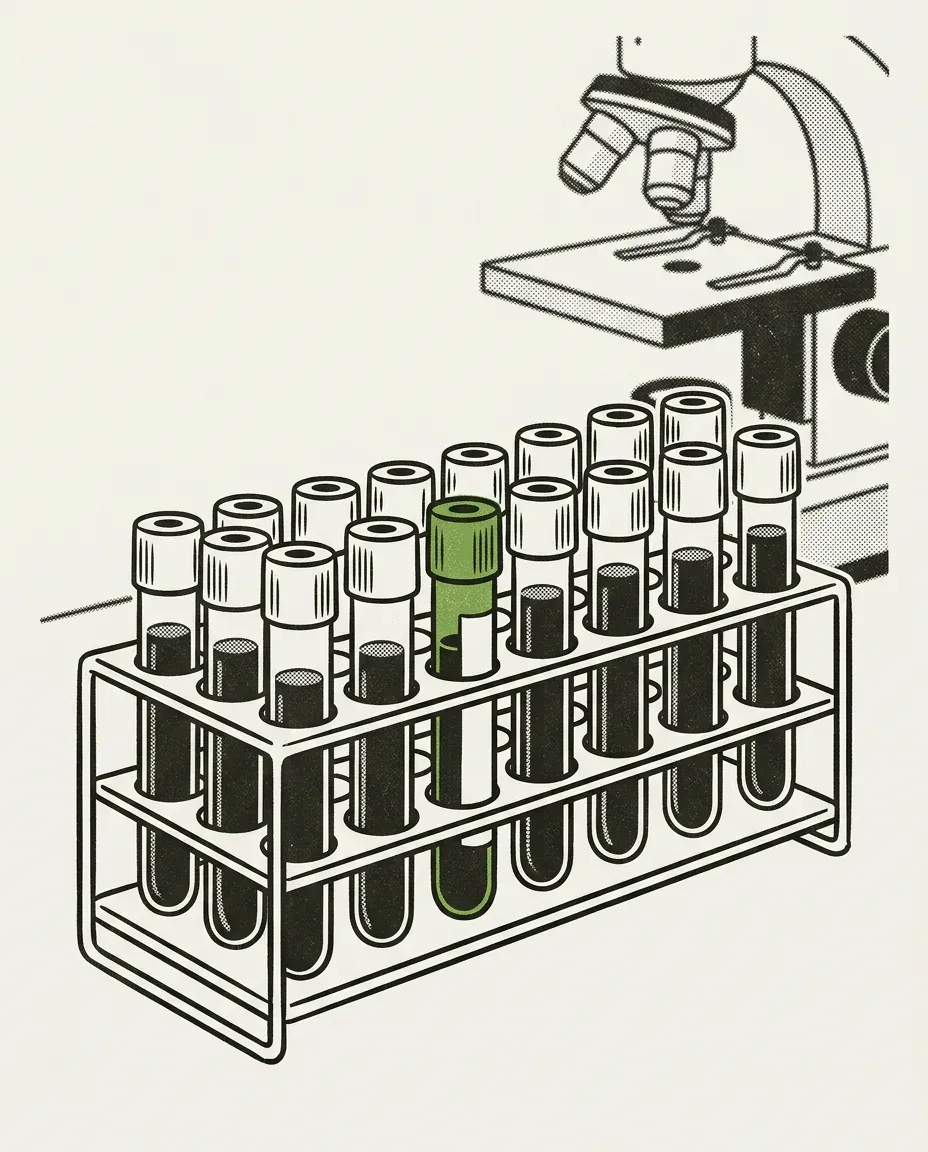
You know the moment. You collect a result, you hear “it's all normal” thrown out in passing, and you leave with a printout where every number sits politely in its little range. Except in the morning you've still nothing to get up on, after lunch your head's like cotton wool, your hair stays on the brush, and sleep is as if it never happened.
Or you've got a stack of results in a drawer nobody ever explained to you properly. You got a narrow little panel, heard “your sugar's fine, your thyroid's fine”, and went home with a quiet suspicion that maybe it really is all in your head.
It isn't. And nobody lied to you. It's just that ten minutes of an appointment and a tick-list from one sheet leave no room to look at the right number from the right angle.
“Your results are normal, so you're healthy.”
Think about where that range even comes from. The lab collects blood from everyone who came in to be tested that day. Among them the healthy, but also people with deficiencies, on a fistful of medicines, with quiet inflammation, after a sleepless night. From that whole mixture you cut off the extreme few per cent top and bottom, and what's left in the middle gets the label “reference range”. So the range describes the average of a population that mostly doesn't feel marvellous anyway. The optimum is something else entirely: a narrower window, drawn from studies asking at what level of a marker people genuinely live longer and feel better. And that's the one we're interested in.
It's enough to swap one question. Not “am I in the range”, but “is my result where the body works best”. Sounds like a trifle, and it changes everything, because suddenly you read each number on your own terms instead of waiting for a single summary sentence from the surgery.
Let me say straight away what this isn't. It isn't a tool for diagnosing yourself at night or for coming off medicines on your own. It's something simpler and stronger: learning to read your own blood, marker by marker. I'll show you where the “range on the printout” ends and the level where the body actually works begins, and where the line runs beyond which the only sensible move is a phone call for help. No magic. With the red flags written out hard.
Inside I lay out, group by group, what you won't hear behind an “it's all normal”:
- ●
Glucose is a late marker. Insulin warns years earlier. The pancreas can hold sugar in check for years by pumping out more and more insulin. Joseph Kraft measured the two together in a huge group and showed that in many people with “tidy” glucose the insulin pattern was already long abnormal.
- ●
TSH alone is too little. TSH is a signal from the pituitary, not a measure of active hormone in the cells. You can have TSH in range and symptoms of an underactive thyroid. What counts is fT3, fT4 and anti-TPO. Whoever ordered you TSH alone checked the pituitary, not the thyroid.
- ●
Haemoglobin falls last. Ferritin first. Before haemoglobin so much as twitches, the body quietly eats its iron reserves. Ferritin shows those reserves, and its lower lab limit is set absurdly low — a recipe for fatigue and worse conversion of thyroid hormone.
- ●
Total cholesterol is a poor signpost. In a lipid panel the most is said by triglycerides and their ratio to HDL, which you work out yourself. A high ratio is among the most sensitive signals of insulin resistance, often long before glucose shows anything. Robert Lustig and Benjamin Bikman showed how far raised insulin reaches.
- ●
hsCRP and homocysteine work in the background. High-sensitivity CRP picks up the quiet, smouldering inflammation that gives no loud symptom for years. Homocysteine tells you whether methylation metabolism is asking for attention. Both almost never make it into a panel as a matter of course.
What's inside
- ✓
An optimum at every marker — two numbers side by side: the one on the printout and the target one. Metabolism, thyroid, iron, vitamin D, inflammatory markers, lipids. You know where you really are.
- ✓
Where the lab range comes from — a thinking tool, after which you read every result differently. It's not a conspiracy, it's the statistics of a population that feels average anyway.
- ✓
Interpretation card to print — every marker with a column for your own result. You print it, write in the numbers and see at once where you are against the optimum.
- ✓
Tests checklist to order — ready to take to the lab, with prep instructions (fasting, biotin stopped, time of the draw), so you don't wait for someone to offer a broader panel.
- ✓
Red flags — values at which the only right move is fast contact with a doctor or emergency care. Naturopathy doesn't compete with emergency medicine.
- ✓
How to talk to your GP — what to ask for plainly, how to prepare for the draw so results are reliable, and how to read markers together, not one in isolation.
This is for you if
- ✓you hear “your results are normal”, and yet you don't feel well
- ✓you have chronic fatigue that neither sleep nor lifestyle explains
- ✓you got a narrow panel and nobody explained what the numbers mean
- ✓you've got results in a drawer you don't understand
- ✓you want to test preventively, before disease shows up, not after the fact
This isn't for you if
- ✕you're looking for a tool to diagnose yourself instead of talking to a doctor
- ✕you want one number to settle everything, without reading results together
This guide teaches you to read results towards the optimum, that is calm, long-term work on yourself. But there are values at which the only right move is fast contact with a doctor or emergency care: glucose or HbA1c in the diabetic range, very low haemoglobin, white cells or platelets well out of range, a reduced eGFR, markedly raised liver tests, extreme ferritin with an inflammatory marker. Inside you have this list written out plainly. The optimal ranges are directional targets based on research and practice, not thresholds for diagnosing disease, which a doctor sets. Results are read together, not one in isolation. If you ever feel acutely unwell, call 999, or 111 for urgent advice. Naturopathy doesn't compete with emergency medicine and never should.
“A result in the range” is not a diagnosis of health. It's information that you fit the statistics.
For decades the whole system learned to look in one place that's too narrow. Glucose instead of insulin. TSH alone instead of the whole thyroid. Haemoglobin, though it's ferritin that falls first. Total cholesterol, though the triglyceride-to-HDL ratio says more. This isn't the fault of the person in the white coat across the desk — they work on what they were taught and on the ten minutes they're given. The enemy is the doctrine that had us measuring the wrong thing. And once you learn to read your own blood, you can't unlearn it, and you never again leave the surgery on someone's single sentence.
Read your own blood: what your appointment skips — have it right now
The PDF lands in your inbox the moment you pay. Read it on your phone, tablet or computer. Your copy is marked with your details (a named licence), for your own use.
Reading your bloods is only the map. Most often it leads straight to two subjects: insulin resistance (HOMA-IR, triglycerides to HDL) and the thyroid (TSH, fT3, anti-TPO). With the three-guide bundle you add Insulin resistance and Hashimoto's for less, while All-Access gives you every guide. See the bundles.
“The first thing after which I stopped looking only at whether a number was in bold red. I understood the difference between “in range” and “optimal”, took my old results out of the drawer and read them anew. The printable card is genius.”
A guide hands you the map. If you would rather go through your case with me, with a plan built around your results and your medication, come to a consultation.
See consultations