Your cholesterol is “too high”. Your arteries say otherwise.
You pick up your result, see cholesterol in red and hear that it would be a good idea to start a statin. You leave feeling you’re carrying a ticking time bomb, with every egg and every knob of butter bringing you closer to a heart attack. Yet cholesterol isn’t a poison, it’s one of the most important building blocks you have, and your cardiac risk is decided by something entirely different from one number on a lipid panel.
You’re afraid of your own plate. You put aside eggs, butter and meat because “they raise cholesterol”, though nobody has explained what those numbers really mean.
You’re offered a statin as prevention, though you’ve never had a heart attack, and there’s heart disease in the family and you want to know what to actually check. Or you take a statin and you’re plagued by muscle aches and a drop in energy.
This isn’t hysteria or a lack of willpower. It’s fear driven by a simple story that misses what really damages the arteries.
“Your cholesterol is high, so you’re at risk of a heart attack, take a statin.”
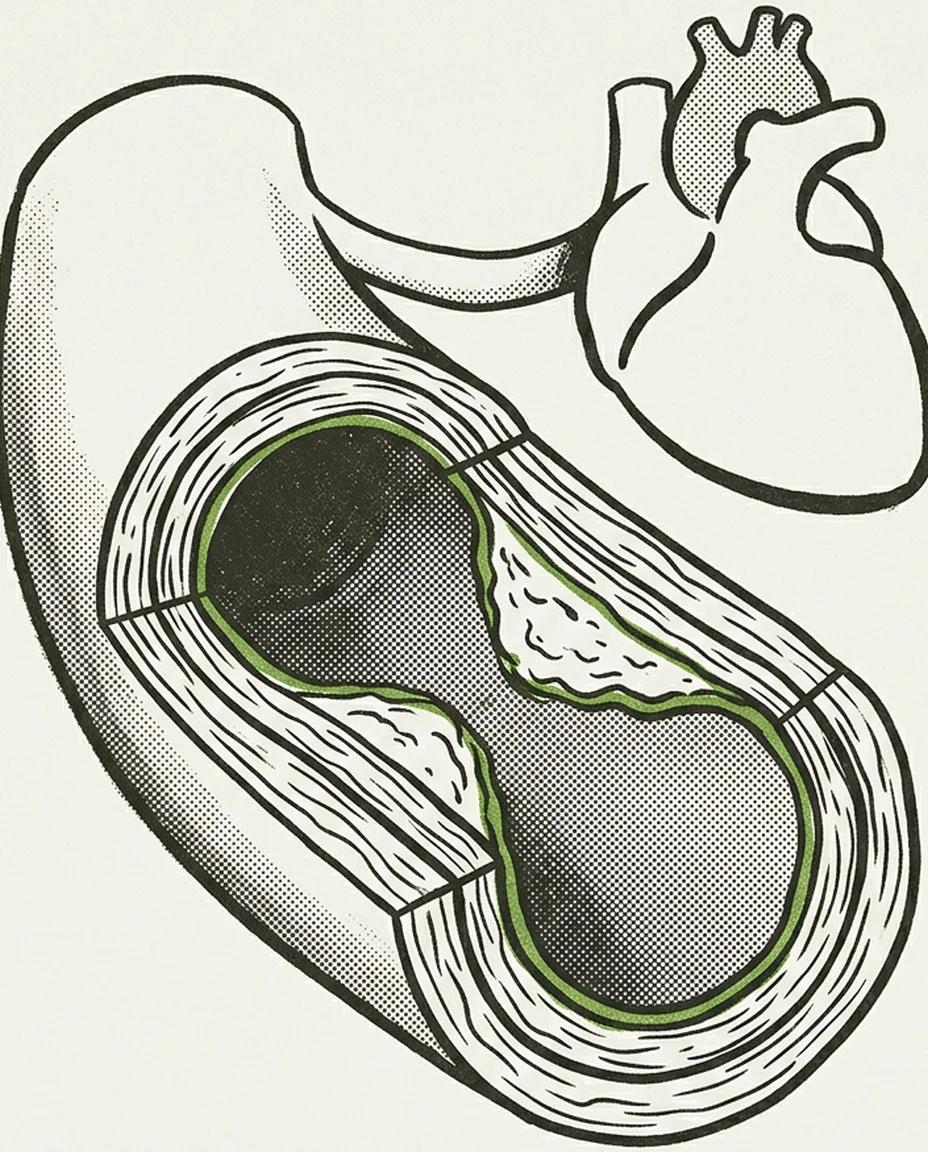
A convenient, simple picture, the artery as a pipe and cholesterol as a deposit on the walls, just physiologically misleading. Atherosclerosis doesn’t start with cholesterol floating in the blood, but with damage to the delicate vessel lining by high blood sugar, inflammation, smoke and high blood pressure. Cholesterol turns up at the scene like a firefighter at a fire, and mistaking it for the culprit is like blaming the firefighters for the blaze, because they’re always where it’s burning.
There’s another way. It starts with understanding that risk is spoken of by metabolic markers almost nobody has shown you: triglyceride to HDL, the number and type of particles, inflammation, not total cholesterol itself.
This isn’t a guide about miracles or reversing atherosclerosis in two weeks. It’s a practical guide: how to understand what really damages the arteries, and how to work on it on your plate, not just at the chemist’s. No magic, no scaremongering, no promises nobody can keep. My enemy in this guide isn’t doctors, it’s an old doctrine that cholesterol simply clogs the arteries, and the industry that profits handsomely from that simple story.
Inside, I break down what you won’t hear at the prescription pad:
- ●
It isn’t cholesterol itself. Atherosclerosis starts with damage to the endothelium, the vessel lining, by sugar, inflammation, smoke and pressure. Cholesterol is only drawn into the repair process. Malcolm Kendrick describes atherosclerosis as a process of damage and repair of the vessel wall, not a clogging of a pipe with fat.
- ●
The type of particle counts, not the number alone. LDL and HDL aren’t two kinds of cholesterol, they’re carriers. Large, fluffy particles are largely harmless, while small, dense ones slip into the vessel wall more easily and oxidise, driven by sugar and processed carbohydrate. It’s the number of atherogenic particles, measured as ApoB, that says more about risk than classic cholesterol, as Allan Sniderman points out.
- ●
Oxidation is the danger. Cholesterol only becomes dangerous once it goes rancid inside the artery wall. It’s oxidised most by industrial seed oils, rich in unstable polyunsaturated fats, and by chronically high blood sugar. The problem isn’t the animal fat humans have always eaten, it’s modern seed oils and sugar.
- ●
Lower isn’t always better. In older people a higher LDL level wasn’t linked to higher mortality at all, and often the opposite, as Uffe Ravnskov points out. Cholesterol is a building block of hormones, cell membranes and the brain, so mindlessly chasing it down isn’t a goal in itself.
What's inside
- ✓
An “is this you?” test — a short picture of signals to tick off (cholesterol in red, a statin in prevention, fear of the egg, high triglycerides, a spare tyre round the middle, family history).
- ✓
The mechanism without the panic — why arteries are damaged by inflammation, sugar, insulin resistance and oxidation, not cholesterol itself, and what that means for your plan.
- ✓
A marker table — what to order (triglycerides, HDL, their ratio, ApoB, lipoprotein(a), hs-CRP, glucose with insulin and HOMA-IR, HbA1c, the calcium score) and how to read the results: lab normal versus the picture of risk.
- ✓
Diet step by step — you remove the seed oils and sugar that oxidise and inflame, go back to real fats and protein, add fish and omega-3.
- ✓
Supplements with ranges — omega-3, coenzyme Q10 as ubiquinol, magnesium, vitamin K2 as MK-7, vitamin D, with hard warnings around medication and learning to read labels (form and purity, not the brand name).
- ✓
Scenarios — high LDL with a great metabolism, high triglycerides with low HDL, after a heart attack or stent, familial hypercholesterolaemia, muscle aches on a statin, alertness in women.
- ✓
Red flags — when to put the guide down and call for help, and when to see a doctor.
- ✓
A printable tests checklist — you take to the lab or show your GP, an end to being fobbed off with one cholesterol number.
- ✓
A 90-day plan — month by month: cut what oxidises, strengthen the metabolism, review and fine-tune.
- ✓
A shopping list to start — what goes in the basket, what comes out of the cupboard.
This is for you if
- ✓you get a result with cholesterol in red and don’t know whether to panic
- ✓you’ve been offered a statin as prevention, though you’ve never had a heart attack
- ✓you’re afraid to eat eggs, butter and meat because “they raise cholesterol”
- ✓you have high triglycerides, low HDL or a spare tyre round the middle
- ✓there’s heart disease in the family and you want to know what to actually check
- ✓you take a statin and want to understand the whole picture before talking to your doctor
This isn't for you if
- ✕you’re looking for permission to stop a medicine on your own (you won’t find that here, your doctor decides about medication)
- ✕you want a ready-made diet without understanding why sugar and seed oils harm the arteries more than butter
Working on your metabolism is part of working on your health, not an experiment to run on your own. One rule is absolute here: don’t stop a statin or any heart or blood-pressure medicine on your own, because stopping suddenly can be dangerous, and only your doctor decides on the dose and the brand. If pain, pressure or tightness in the chest appears, breathlessness, cold sweat, nausea or signs of a stroke, that is sudden weakness on one side, a drooping corner of the mouth and trouble speaking, you don’t read guides, you call 999. In women the signs of a heart attack can be atypical, so don’t brush off breathlessness, extreme tiredness and back or jaw pain. The guide also gives you hard warnings around supplements: vitamin K2 is contraindicated with warfarin-type medicines without your doctor’s agreement, and CoQ10 and larger doses of omega-3 need caution on blood-thinning medication. Familial hypercholesterolaemia and the period after a heart attack are a doctor’s care, not solo experiments. Naturopathy does not compete with emergency medicine, and it never should.
Cholesterol isn’t the enemy. Your body doesn’t make it in order to kill you.
The liver makes cholesterol itself, regardless of diet, because you need it to build cell membranes, hormones and the brain. The arteries are damaged not by this building block but by inflammation, high blood sugar, insulin resistance and oxidation driven by seed oils, and all of that responds to what’s on your plate. Change the conditions and the metabolic picture changes within a few months. It’s not a sentence or an automatic pill for life, and you decide about medication with your doctor anyway, not in a panic.
Cholesterol and your heart, without the panic — have it right now
The PDF lands in your inbox the moment you pay. Read it on your phone, tablet or computer. Your copy is marked with your details (a named licence), for your own use.
Cholesterol is rarely a problem in itself, because underneath it most often works insulin resistance, which drives small dense particles, high triglycerides and low HDL. With the Metabolic bundle you add Insulin resistance to it for less and work on the real backdrop to atherosclerosis, while All-Access gives you every guide. See the bundles.
“The first thing I read that stopped me fearing the egg and made me understand what to actually test beyond cholesterol itself. Written calmly, no scaremongering, with a concrete list for the lab and a clear rule that I discuss medication with my doctor.”
A guide hands you the map. If you would rather go through your case with me, with a plan built around your results and your medication, come to a consultation.
See consultations